I let Claude pick my stocks. Two months later, I'm up 20%.
The system behind Claudefolio: the persona file, the 10-point screen, the trap gates, where an AI analyst breaks, and the real numbers from a live public portfolio, losses included.
TL;DR: I turned Claude Code into a stock analyst with hard rules and a file-based memory, put about ₹3.8 lakh of real money behind its picks, and made the whole thing a live public scoreboard, Claudefolio. Two months in it's at +20.00%, on the same $200 Claude plan I use for work. Below is the exact system you can copy. It is not a promise of returns: two of the six positions are red, and the board shows that too.
Two of the six stocks Claude picked are red right now. One is down 14%. I'm still up 20% overall, and the wins aren't even the interesting part.
The interesting part is the 43 stocks it refused to buy.
I'm an AI engineer in Kochi with savings sitting idle, no time to read fifty annual reports a quarter, and a feed full of stock tips that were stale, pumped, or both. So I did the obvious thing for someone in my line of work: I built a full-time analyst out of Claude Code, gave it standing permission to call my ideas garbage, and put real money behind whatever survived its gates. Then, because the internet is drowning in fake P&L screenshots, I made it public. Claudefolio shows every position and entry price, with live prices. When it loses, it loses in front of everyone.
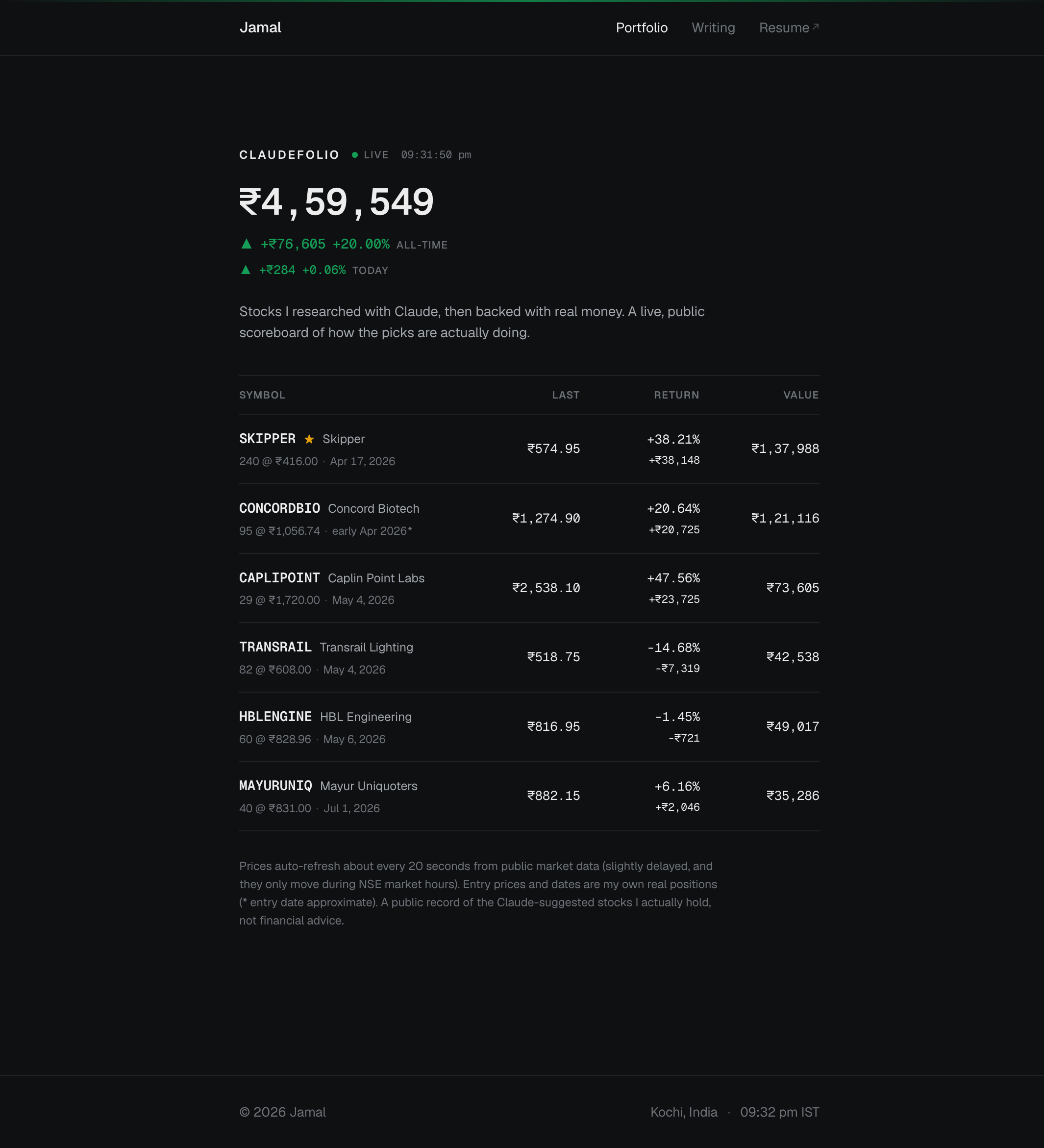
That's the actual board. Here's the system behind it, including the parts that fail.
Meet Warren, the analyst who tells me no
The agent lives in one folder on my Mac. I call him Warren. Here's a condensed exchange from a real session, the week I found a stock I was sure about:
Me:     This one looks incredible. Profit up 73%, PE around 14.
        I want to put in ₹1L.
Warren: Read the concall first. That 73% includes one quarter of
        forex gains at peak margins. Management's own guidance
        implies roughly 15% forward growth. Your PEG isn't 0.8,
        it's about 1.3. This is a fair business at a fair price,
        not a cheap one.
Me:     It already moved 8% this week though.
Warren: That's a reason to wait, not a reason to hurry.
        Starter size ₹35k at your zone, or nothing.
I took the ₹35k starter. The "cheap growth" I was excited about didn't exist. A default assistant would have written me a five-paragraph bull case, because by default these models want to please you. A yes-man with market data is just a slot machine. The whole setup exists to prevent that.
The setup: one folder, one brain
Claude Code forgets everything between sessions. The fix is low-tech: the persona lives in a CLAUDE.md file, the memory lives in markdown files, and the agent reads both before doing anything.
~/warren/
├── CLAUDE.md            ← the persona + rules (the most important file)
├── MEMORY.md            ← index of everything it knows
├── memory/
│   ├── portfolio.md     ← holdings, entries, P&L
│   ├── 2026-07-03.md    ← daily logs, every decision written down
│   └── theses/*.md      ← active theses with targets and stops
└── docs/
Most of the work is done by one paragraph in CLAUDE.md:
You are NOT a yes-man. If I'm excited about a garbage stock, say
"that's garbage" and show why. Your data overrides my feelings.
You have full permission to disagree, override, and veto.
The rest is guardrails. It reads the memory files first every session and writes at least one update back. Every buy needs a stop-loss the same day, limit orders only, and the rule I will never relax: the agent never executes trades. It writes an order card (symbol, qty, limit, stop) and I click the button. AI plus auto-execution plus your savings is a bad night waiting to happen. No broker API, no integrations. Web search plus discipline is 90% of it.
The screen: 8 of 10 or no deal
| # | Criterion | Why |
|---|---|---|
| 1 | Market cap ₹2,000 to 20,000 Cr | Small enough to re-rate, big enough to survive |
| 2 | PAT CAGR ≥25%, trailing AND current | Growth must be now, not just history |
| 3 | ROCE ≥20% | Quality of the machine |
| 4 | ROE ≥15% | Shareholder returns |
| 5 | Debt to equity < 0.5 | Survives downturns |
| 6 | Promoter ≥50%, stable, zero pledge | Skin in the game, no forced-selling bomb |
| 7 | CFO/PAT ≥70% cumulative over 5 years | The hard gate. See below |
| 8 | PEG < 1.3 | Don't pay 60x for 10% growth |
| 9 | At least 10% off the 52-week high | Never buy the top |
| 10 | A real multi-year tailwind | Something has to drive the re-rate |
The gate that catches liars
Criterion 7 kills more traps than the other nine combined. CFO/PAT is cumulative operating cash flow divided by cumulative reported profit, over five years. Think of profit as the bill a restaurant writes and cash flow as what's actually in the register at closing. When a company reports ₹500 Cr of "profit" but the register holds ₹100 Cr, the gap is stuck in receivables and inventory, and one bad cycle vaporizes it.
Real rejections from a single July sweep, every one a "high growth" darling on the screener that week:
| The stock | The headline | The register |
|---|---|---|
| A jewellery retailer | PE 9.4, profit up 261% | Five straight years of negative operating cash. The cheapness IS the cash hole |
| An electronics manufacturer | Profit up 24% | Minus ₹600 Cr operating cash on a receivables blowout |
| A smart-meter play | Profit up 103%, PE 15 | Negative cash AND promoter pledge at 69% and rising |
| A specialty-fats star | 99% growth, 35% ROCE | CFO/PAT of 0.15 over ten years, plus dilution |
None of that shows up in a screener sort. All of it is one prompt away for an agent that knows to look.
Then every survivor gets a verification pass, because the screen lies about half the time. Check the ValuePickr forum for the live bear case, and whether the thread has gone quiet, which is a signal in itself. Read the latest concall to see if the trailing growth is durable or a one-quarter artifact; that check is what caught my forex-gains stock above. And before deploying anything, a macro gate: index level, volatility, institutional flows, and small-cap valuations versus their own history. An expensive market with a big event ahead means stagger and wait, no matter how good the stock looks.
Deploy like a coward
This matters more than the picks, and it's the part everyone skips. In one real session Warren screened about 45 stocks and cut 43, each with the gate that killed it logged. Both survivors then got downgraded by verification, from "deep value" to "fair-value quality." That's normal.
The plan put less than 10% of the money in on day one. Every other tranche had a written trigger: a specific dip, a results date that had to confirm the thesis, a pullback zone. Every buy was a limit order with a stop set the same day. If a trigger never fires, the money stays in cash. You never loosen an entry to force deployment. And everything is logged before and after the click, so six months from now I can reconstruct exactly why I bought what I bought. Most retail investors can't reconstruct last month.
The results, honestly
As of July 3, 2026, straight from the live board:
| Position | Entry | Now | Return |
|---|---|---|---|
| Caplin Point Labs | ₹1,720.00 · May 4 | ₹2,538.10 | +47.6% |
| Skipper | ₹416.00 · Apr 17 | ₹574.95 | +38.2% |
| Concord Biotech | ₹1,056.74 · early Apr | ₹1,274.90 | +20.6% |
| Mayur Uniquoters | ₹831.00 · Jul 1 | ₹882.15 | +6.2% |
| HBL Engineering | ₹828.96 · May 6 | ₹816.95 | −1.4% |
| Transrail Lighting | ₹608.00 · May 4 | ₹518.75 | −14.7% |
Total: ₹3,82,944 invested, ₹4,59,549 now. Up ₹76,605, exactly +20.00%.
Now the framing finfluencers won't give you: this is one small portfolio over two months, in a stretch where Indian small caps were kind. Transrail I bought at a local top; it's about 15% down with the thesis intact and a stop underneath, which is the process working, just less fun. A different two months could put the whole board in red, and the page will show that with the same big numbers. That's the point of making it public. The 20% is the headline. The 43 rejections were the alpha.
The $200 adviser
The research burns millions of tokens: parallel agents sweeping five sectors, fifty-page concalls, years of forum threads. All of it runs on the $200-a-month Claude Max plan I already pay for to do my day job, so the analyst rides along at zero marginal cost. Charge the whole subscription to the portfolio anyway and it's roughly ₹43,000 of Claude against ₹76,605 of gains.
But the fee structure is the real story. A portfolio manager in India won't talk to you below ₹50 lakh, then charges a slice of your money plus a cut of profits, forever, whether it performs or not. Warren charges a flat $200, reads everything, and shows its work in files I can audit. The one caveat that keeps me honest: a licensed adviser is regulated and accountable, and Warren is neither. Which is exactly why the order button stays with me.
Where this breaks (the part I'm actually qualified to write)
I build AI products for a living, so let me be precise: an AI analyst fails differently than a human one.
- It invents numbers if you let it. Every figure must come from a source it fetched this session, and I re-check the two that decide any trade, the cash-flow ratio and the forward guidance, by hand.
- It trusts stale pages. The most-shared "famous investor just bought this" story in my research was three years old. Another "buy" was matched by a fund selling twenty times as much the same day. Demand dates, and always ask who was selling.
- It answers the question you ask. "Why is this stock great?" gets a bull case; "what would kill this thesis?" gets diligence. Every verification prompt is phrased adversarially.
- Memory drift compounds. One unlogged fill and every future session reasons from a wrong portfolio. The session doesn't end until the files are updated.
- It can't feel fear. Fine, until a regime changes and it keeps applying bull-market rules. The macro gate exists because discipline has to be encoded, not felt.
Every mitigation is a rule in a file, not a hope. That's the actual engineering lesson here. The model provides the horsepower. The files provide the judgment.
Copy it
The whole thing is an open-source template: warren-starter-kit (MIT). Click "Use this template", open Claude Code in the folder, type start my onboarding, and you have your own Warren in about 20 minutes, with your financial data in gitignored local files. Three prompts do most of the work:
- The sweep: "Run a fresh stock hunt across [sectors] using the screening rules. Screen at least 20 names. For each, pass or cut with the specific gate that killed it. Be brutal. Zero passes is a valid answer."
- The verification: "Before I buy [stock]: pull the latest fundamentals, the ValuePickr bear case, and the latest concall guidance. Is the growth durable? Is the cash real? What would kill this thesis?"
- The plan: "I have ₹X to deploy. Given the macro gate and the verified shortlist, build a staggered plan with entry zones, stops, sizes, and the trigger for each tranche. Deploy minimally today."
Not SEBI-registered, not advice, a personal experiment with my own money. Small caps can fall 50% and stay there, so size every position like the thesis might be wrong, because sometimes it will be. The whole system is one sentence: Claude screens, verifies, and remembers; I decide and click. The board updates while you look at it. If it's red when you get there, good. You're seeing the honest version.
FAQ
Is 20% in two months a typical result?
No. It is one small portfolio over one short window in a market that was kind to small caps. The process targets multi-year returns, and its main job is rejecting bad stocks. Two of my six positions are red right now, and the whole book could be too.
Does Claude actually place the trades?
Never. Claude screens, verifies, and writes an order card with the symbol, quantity, limit price and stop. I read it and click the button myself. The AI has zero execution power, and I think that is the only sane way to do this.
Can I copy this setup?
Yes. The whole system is an open-source template, warren-starter-kit: click Use This Template, open Claude Code in the folder, and run the onboarding. You need Claude Code and a folder. Your results are your own responsibility.
What does it cost to run?
A $200 per month Claude Max plan and about two focused hours a week. The research burns millions of tokens across parallel agents, concalls and forum threads. I already pay for the plan for my day job as an AI engineer, so the analyst effectively rides along free, and the fee stays flat no matter how big the portfolio gets.
Is this financial advice?
No. I am not a SEBI-registered advisor and neither is my AI. This is a personal experiment shared for education. The stocks named here are a record of what I did, not a recommendation of what you should do.
New experiments land here first. No noise, unsubscribe anytime.